Chapter 6, Bower (2017) Design of Technology-Enhanced Learning: Integrating Research and Practice
Initial Thoughts
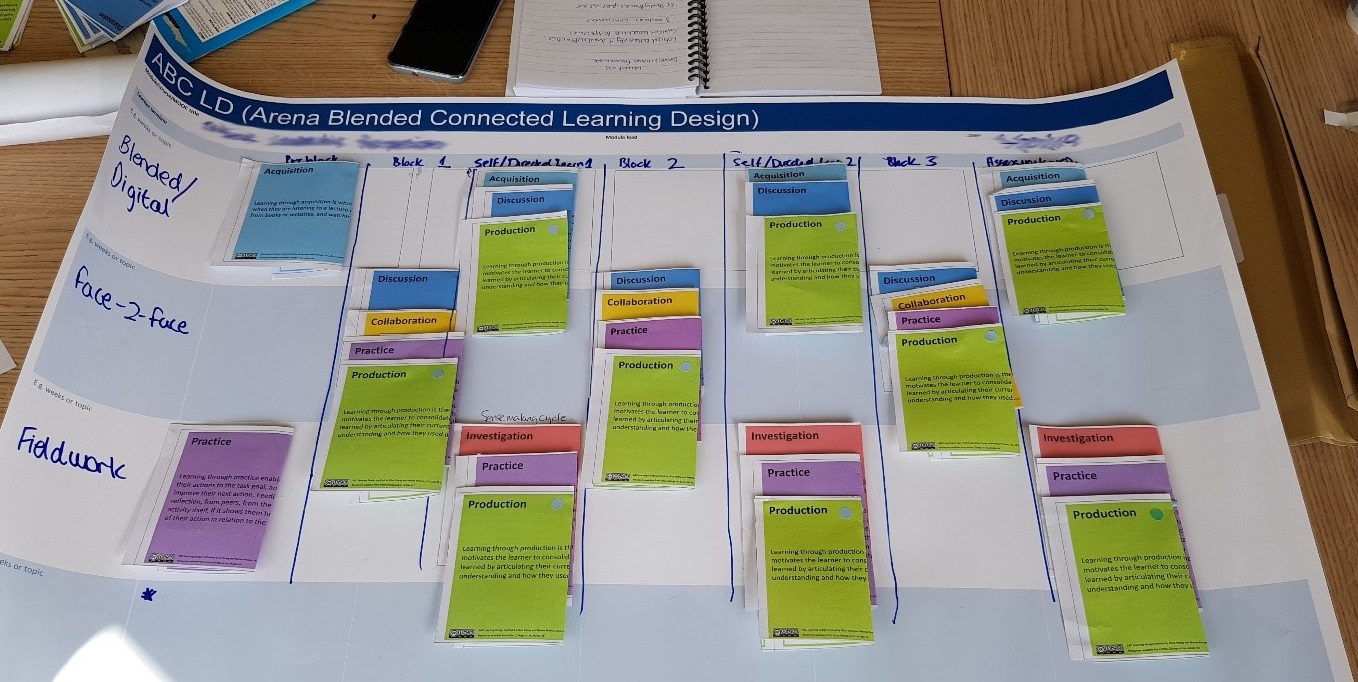
This week’s task was to read an allocated chapter of the core book for the Investigating TEL module. When I discovered that chapter 6 was Designing for Technology Enhanced Learning I was delighted. I have been doing a lot of thinking about learning design lately, especially in respect to blended learning design through the curriculum design and development projects I am leading. I am already using some of the learning design approaches in the Curriculum Design session I have facilitated for academics. These sessions are based on the Arena Blended Connected (ABC) Curriculum Design Method . ABC curriculum design is an engaging hands-on, card-based design method. It is built on curriculum design research from the JISC* (Viewpoints) and Diana Laurillard’s six learning types
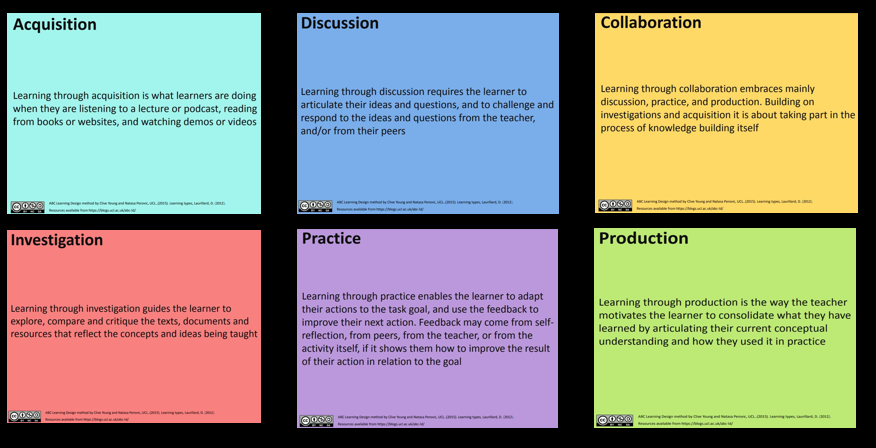
And adapted by University Colleague London (All ABC resources are released under Creative Commons). Through a 90-minute rapid design approach that allows teaching teams to identify the types and sequences of learning activities through a visual storyboarding approach. It also gives teaching teams the opportunity to engage in those critical design conversations. Resulting in richer blending learning designs. This of course is the beginning of the design process and my usual approach is to translate the design onto a Trello. I then use the Trello design board to manage the curriculum design process and any digital development work. The idea is that once all design iterations are complete (and there are often many iterations) the design is then built on the Virtual Learning Environment (VLE).
Chapter Review
Bower’s, approach to this chapter is to firstly define and consider designing and design thinking as a discipline, which seems like a good place to start. The idea is that this provides the fundamental knowledge for designing for learning or learning design as it is later referred to. I found it useful to start to consider the chapter in this structured, systematic way. In explaining what design is, Bower uses the work of many scholars but what I take away from this is that design involves, purposeful activity, critical thinking, structured practice and scientific reflection. Design also encompasses both art and sciences. I can certainly relate to some of these principles in my own learning design practices, which are often complex iterative and challenging. A feel a little reassured that the complexities are because it actually is messy and complex.

As I now begin to feel a little reassured, we move on to focusing on the notion of ‘design thinking’, which in the simplest form are the thinking skills that underpin the design. In the not so simplest of forms, Bower, points to 10 aspects of design thinking:

The chapter continues to evolve, highlighting the concept of viewing teaching as a design science, a discipline in its own right. As it uses what is known about teaching and learning to achieve the goal of student learning (Laurillard 2012). I think this emphasises the role that technology is having on the nature of learning and learning design. It also makes me think about the changing role of the teacher, which I started to highlight on my blog home page. The changing landscape of education through TEL and the move towards more flexible modes of delivery and the pedagogical challenges and opportunities this brings (Gordon 2014).
Another key challenge to highlight is the role of reflection in the design process and the developments that can be achieved through ‘reflection-in-action’. Consideration for the pedagogic intention of designing for learning and maintaining the focus on the learner. A distinction is made between a learning task and a learning activity. What Bower is referring to here is the view that learning can never be wholly designed, only design for i.e. the learner will take the task definition, interpret and modify it (in their own way) and the activity is a representation of that task. Learner autonomy adds yet another layer of complexity to the learning design process. We cannot assume the learners’ behaviour is under control or that they are complaint learners, as students rarely use technology the way they are obliged to do so (Goodyear 2000). This is why a robust pedagogical strategy is vital so that learning tasks are positioned and guided with clear scaffolding.
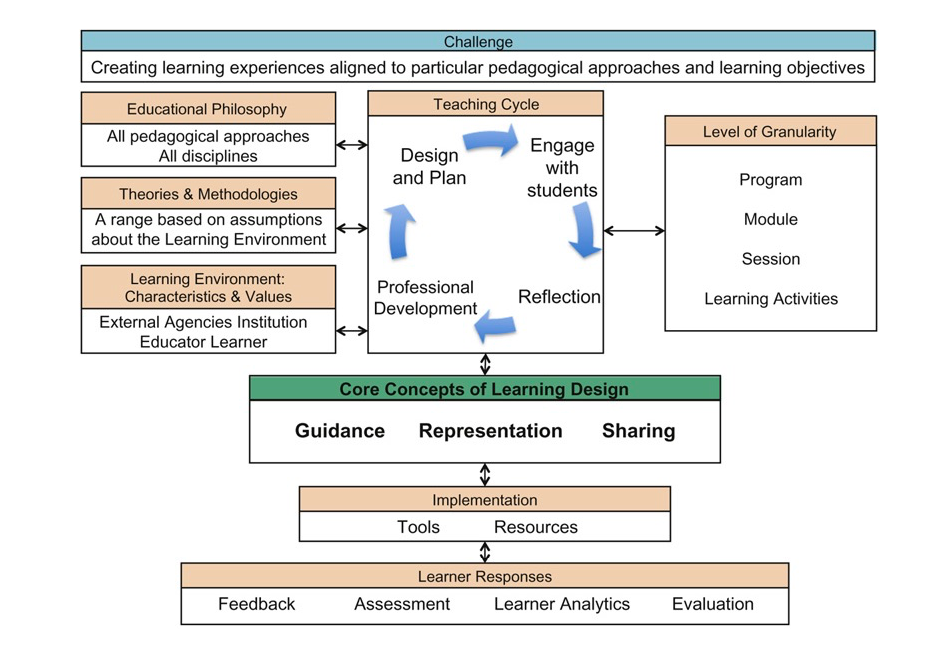
A Learning Design Conceptual Map is discussed as a general, descriptive framework of Learning Design and a useful referent for designers. It does not provide any guidance or recommendations, but I think it is helpful in consideration of the key concepts and interrelationships of the learning design challenges.
References
Laurillard, D., 2013. Teaching as a design science: Building pedagogical patterns for learning and technology. Routledge.
Gordon, N. (2014) Flexible Pedagogies: technology-enhanced learning. Higher Education Academy.
Goodyear, P. (2000) ‘Environments for lifelong learning’, in Integrated and holistic perspectives on learning, instruction and technology. Springer, pp. 1-18.


Thank you Michelle, another very interesting (albeit lengthy) blog! I’m glad that the chapter helped to reassure you about the complex and messy nature of learning in general. Its complex and messy even before you introduce technology! Perhaps it is important to recognise this when attempting to introduce technology – although Im not sure what would need to change in practice. Thank you for adding links to ABC, JISC and the conversational framework. I have use the ABC approach before and found it very useful. In fact I think every module leader across the university would benefit from using it. I liked it because it meant that the process of design immediately became a social interaction instead of me just sitting in front of a computer pondering on my own internal thoughts. It will be interesting to see if/how the use of CANVAS can be integrated into the ABC approach. This would add a lot of value. The article on CANVAS that we read and discussed last week also referred to the potential of using CANVAS to help in the design process itself.
With reference to format:
– using diagrams with lots of words is a great way to keep your word count down.
– if your blogs are this long then a photo from unsplash will help to breakj up the text!
LikeLiked by 1 person