Featured

Technology Enhanced Learning – Conclusions and Future Direction

Chapter 12, Bower (2017) Design of Technology-Enhanced Learning: Integrating Research and Practice

Initial Thoughts…

My next task for this module is to provide a reflective summary of the Chapter 12 of the core eBook. My first disclaimer is that I have not read the whole book (although I really wish I had) admittedly I have read chapter 6 and this chapter as allocated to me by James. I would have loved to indulge further (and will certainly set some time aside for this) but I have not been able to find the time in the busyness of life… Despite this, I do feel that James’ approach to collaboratively exploring this eBook within a group setting has been very beneficial. Each student was allocated two chapters each. Our task was to read and reflect upon this, using our blog space, and then to collectively discuss as a group. The opportunity to explore understanding and appreciate the different approaches to evaluating the chapters has been interesting. 

Personally, I think this approach is a great example of using TEL to flip learning, by introducing the learning concepts (in this case the eBook chapters and online reflective piece) outside of the classroom space, and then using the classroom time to deepen understanding through collaborative discussion (Gordon 2014).
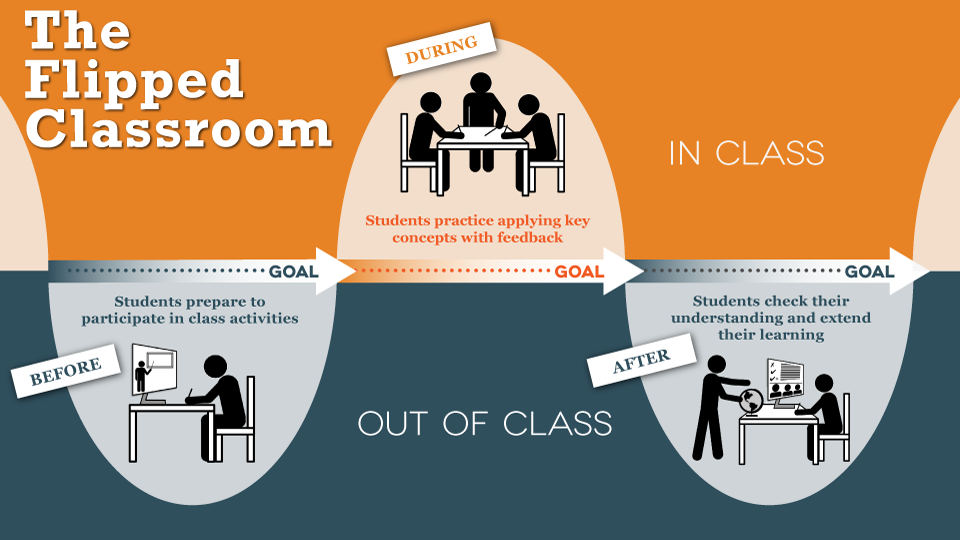
The Flipped Classroom

There has been a consistent approach throughout the module that has included some individual investigations into learning management systems in general, and Canvas as the new VLE for this university, followed by in class discussion.  Some of this I will explore in subsequent blogs, but for now I am going to turn my attention to the conclusions and future directions outlined in chapter 12. 

Chapter Review…

The chapter abstract claims that the book provides the foundations on which to build TEL, both now and in the future. This is based on research to date, historic trends, educator support and a showcase of impactful technologies. Impactful is defined as those that offer visceral learning experiences, real world experiences through technology. It is clear from this chapter that a collaborative approach to TEL design is important and that it should be research-driven and pedagogically underpinned. This is a familiar approach to my own working practices. I take a triadic approach to learning design; Goal (learning outcomes), Action (learning activities), role of technology. I also have a strong sense of the importance of educator and student support and training, and the need for sustainable TEL approaches. By this I mean accessible technology tools rather than advanced skills tools. Those that educators can adopt with ease, comfort, and confidence. Especially given the current climate in HE and the pressure of TEL innovation with limited time and resources (Garrison, D.R. and Vaughan, N.D.2013).

This brings me onto the drivers for TEL and the first of the six section of this chapter: The Current State of TEL Learning Design. Whilst highlighting some of the drivers e.g. access to learning, digital learning skills, it also dispels assumptions such as students will automatically know how to use learning technologies. This I believe is essential in successful design. Students will without doubt be familiar with certain technologies. For example, disruptive technologies identified by Flavin (2017) such Google Search and Wikipedia, but…that does not necessarily mean they know how to use these technologies effectively within the learning process, or that they will understand the use of technologies such as quizzing tools or navigate the virtual learning environment or learning management system. This will ultimately require an effective pedagogical strategy, such as clear scaffolding and guidance. I think this chapter provides a good basis for understanding the pedagogical complexities of TEL design by explaining pedagogy as three separate elements: Pedagogical perspectives (learning theories and beliefs) such as behaviorism or social constructivism, Pedagogical approaches such as collaborative learning or experiential learning, and Pedagogical strategies such as positioning, questioning and scaffolding. It also recommends the TPACK model as a framework that can help educators to consider the different areas of technologies integration and the relationship between technology, pedagogy and content knowledge.
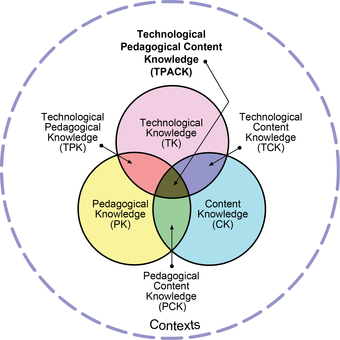
TPACK Famework

TPACK is the result of many years of research focusing on teaching and learning practices in HEIs and emphasises the importance of teachers having technological understanding (Mishra and Koehler, 2006). The key elements of the TPACK framework are:

  • Technology knowledge (TK): knowledge of digital and non-digital technologies
  • Pedagogical knowledge (PK): knowledge of the teaching methods and approaches
  • Content knowledge (CK): knowledge of the subject discipline
  • Pedagogical content knowledge (PCK): Discipline specific pedagogical knowledge that addresses effective ways of teaching a topic
  • Technological content knowledge (TCK): Understanding technologies and how they can be used to represent content
  • Technological pedagogical knowledge (TPK): Understanding how certain technologies can be used for educational purposes
  • Technological pedagogical and content knowledge (TPACK): Collegial knowledge of using technology for pedagogical purposes in a way that supports the student’s development of content knowledge

Using the TPACK framework at the learning design phase can support technology integration discussions from a theoretical, pedagogical, and methodological perspective. TPACK can guide curriculum design conversations and help teaching teams create conceptual and seamless learning environments and facilitate key discussions and teacher knowledge in effective technology integration (Mishra and Koehler, 2006). Whilst TPACK can be used to shape key design conversations, Bower highlights that it provides little guidance on the types of flexible pedagogies or what technologies might be useful. 

Technology Confusion

What is interesting is the notion of positioning teaching as a design science. If this is something that interests you then I would advise reading Diana Laurillards’ book ‘Teaching as a Design Science’ (2012). Another interesting aspect, and something that I explore within my practice, is the pedagogical flexibility that TEL creates and approaches such as flipped learning, blended learning, flexible learning and social learning. The enhancements and advances that can be afforded by TEL. TEL has significant potential to change the way we learn, what we need to know and how we come to now it (Flavin 2017). This of course rests on the shoulders of the educators and their ability to develop a deep understanding of the design process. There are many barriers and issues identified by Bower, and he highlights these as: technical and digital capabilities, cognitive load, collaboration problems, negative dispositions, and inappropriate learning design. As I have mentioned in my previous blogs a complex and often messy process…

References

Flavin, M. (2017) ‘Disruptive Technology Enhanced Learning’.

Garrison, D.R. and Vaughan, N.D. (2013) ‘Institutional change and leadership associated with blended learning innovation: Two case studies’, The Internet and Higher Education, 18(Supplement C), pp. 24-28.

Laurillard, D., 2013. Teaching as a design science: Building pedagogical patterns for learning and technology. Routledge.

Gordon, N. (2014) Flexible Pedagogies: technology-enhanced learning. Higher Education Academy.

Mishra, P. and Koehler, M.J. (2006) ‘Technological pedagogical content knowledge: A framework for teacher knowledge’, Teachers college record, 108(6), pp. 1017-1054.
Featured

Design Thinking and Learning Design

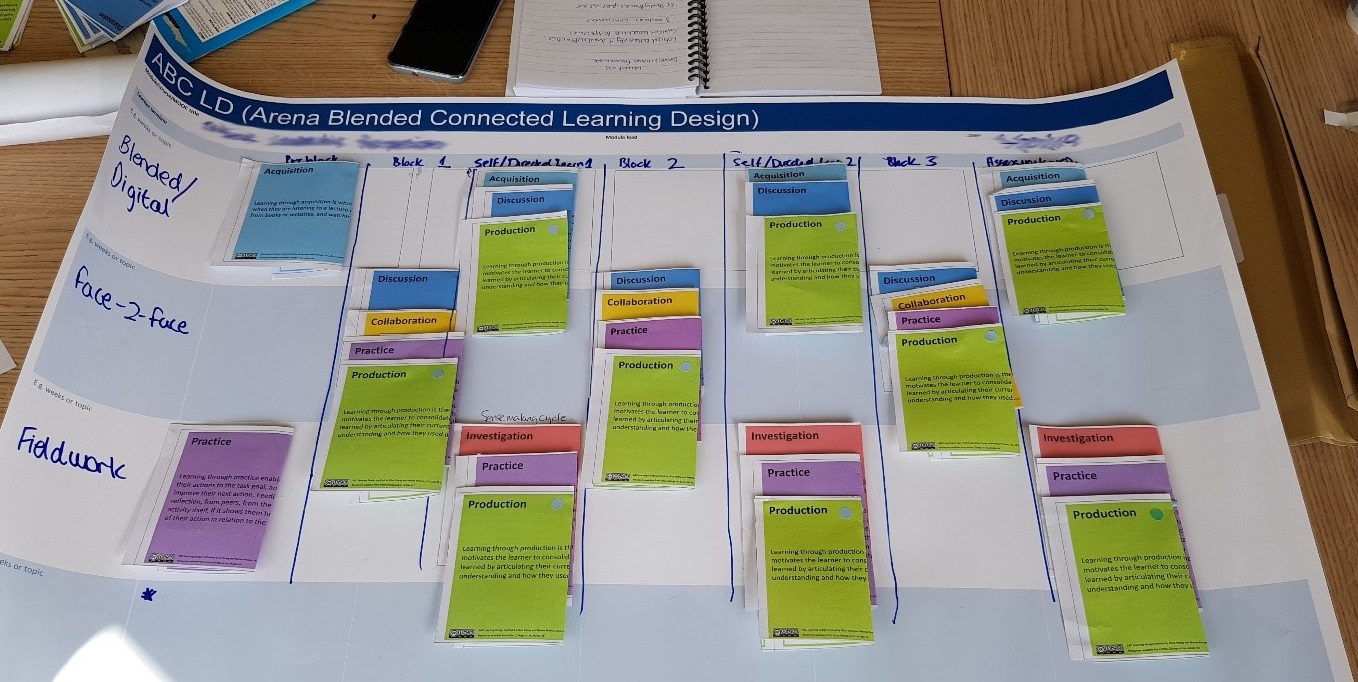
ABC Curriculum Design Storyboard

Chapter 6, Bower (2017) Design of Technology-Enhanced Learning: Integrating Research and Practice

Initial Thoughts

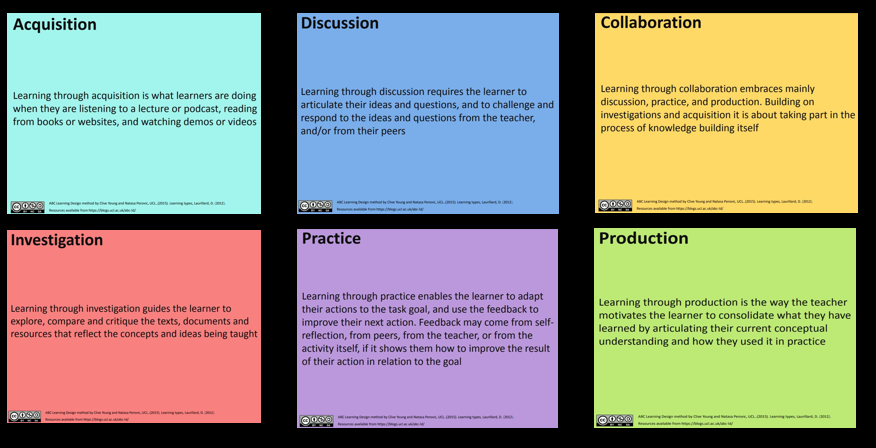
This week’s task was to read an allocated chapter of the core book for the Investigating TEL module. When I discovered that chapter 6 was Designing for Technology Enhanced Learning I was delighted. I have been doing a lot of thinking about learning design lately, especially in respect to blended learning design through the curriculum design and development projects I am leading. I am already using some of the learning design approaches in the Curriculum Design session I have facilitated for academics. These sessions are based on the Arena Blended Connected (ABC) Curriculum Design Method  . ABC curriculum design is an engaging hands-on, card-based design method. It is built on curriculum design research from the JISC* (Viewpoints) and Diana Laurillard’s  six learning types

Diana Laurillard’s Six Learning Types

And adapted by University Colleague London (All ABC resources are released under Creative Commons). Through a 90-minute rapid design approach that allows teaching teams to identify the types and sequences of learning activities through a visual storyboarding approach. It also gives teaching teams the opportunity to engage in those critical design conversations. Resulting in richer blending learning designs. This of course is the beginning of the design process and my usual approach is to translate the design onto a Trello. I then use the Trello design board to manage the curriculum design process and any digital development work. The idea is that once all design iterations are complete (and there are often many iterations) the design is then built on the Virtual Learning Environment (VLE).

Chapter Review

Bower’s, approach to this chapter is to firstly define and consider designing and design thinking as a discipline, which seems like a good place to start. The idea is that this provides the fundamental knowledge for designing for learning or learning design as it is later referred to. I found it useful to start to consider the chapter in this structured, systematic way.  In explaining what design is, Bower uses the work of many scholars but what I take away from this is that design involves, purposeful activity, critical thinking, structured practice and scientific reflection. Design also encompasses both art and sciences. I can certainly relate to some of these principles in my own learning design practices, which are often complex iterative and challenging. A feel a little reassured that the complexities are because it actually is messy and complex.

As I now begin to feel a little reassured, we move on to focusing on the notion of ‘design thinking’, which in the simplest form are the thinking skills that underpin the design. In the not so simplest of forms, Bower, points to 10 aspects of design thinking:

Infographic – 10 aspects of Design Thinking (Michelle Barr 2020, adapted from Bower 2017)

The chapter continues to evolve, highlighting the concept of viewing teaching as a design science, a discipline in its own right. As it uses what is known about teaching and learning to achieve the goal of student learning (Laurillard 2012). I think this emphasises the role that technology is having on the nature of learning and learning design. It also makes me think about the changing role of the teacher, which I started to highlight on my blog home page. The changing landscape of education through TEL and the move towards more flexible modes of delivery and the pedagogical challenges and opportunities this brings (Gordon 2014).

Another key challenge to highlight is the role of reflection in the design process and the developments that can be achieved through ‘reflection-in-action’. Consideration for the pedagogic intention of designing for learning and maintaining the focus on the learner. A distinction is made between a learning task and a learning activity. What Bower is referring to here is the view that learning can never be wholly designed, only design for i.e. the learner will take the task definition, interpret and modify it (in their own way) and the activity is a representation of that task. Learner autonomy adds yet another layer of complexity to the learning design process. We cannot assume the learners’ behaviour is under control or that they are complaint learners, as students rarely use technology the way they are obliged to do so (Goodyear 2000). This is why a robust pedagogical strategy is vital so that learning tasks are positioned and guided with clear scaffolding.

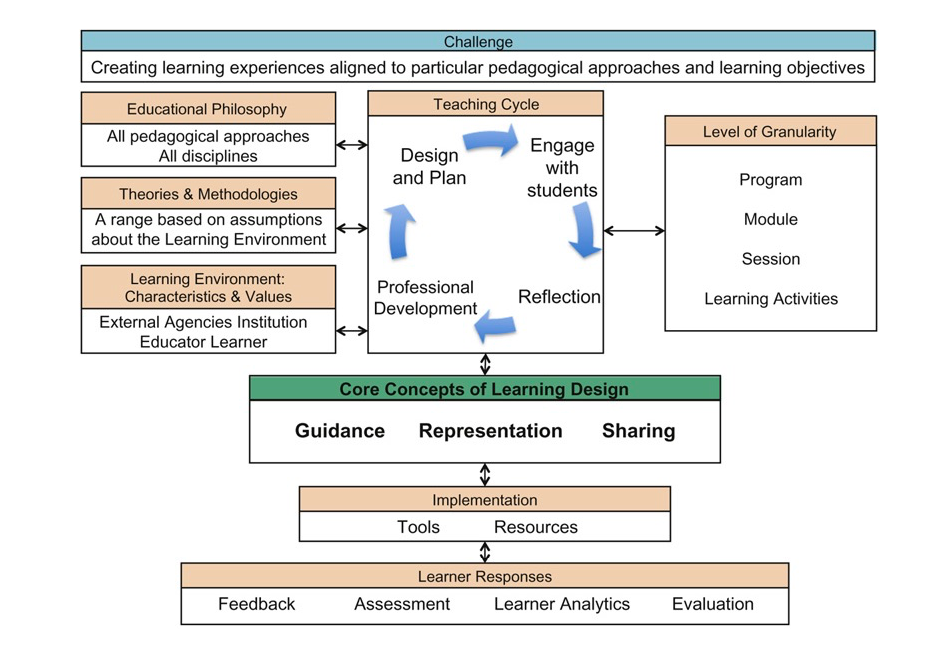
A Learning Design Conceptual Map is discussed as a general, descriptive framework of Learning Design and a useful referent for designers. It does not provide any guidance or recommendations, but I think it is helpful in consideration of the key concepts and interrelationships of the learning design challenges.

A Learning Design Conceptual Map
A Learning Design Conceptual Map (Dalziel et al, 2016)

References

Laurillard, D., 2013. Teaching as a design science: Building pedagogical patterns for learning and technology. Routledge.

Gordon, N. (2014) Flexible Pedagogies: technology-enhanced learning. Higher Education Academy.

Goodyear, P. (2000) ‘Environments for lifelong learning’, in  Integrated and holistic perspectives on learning, instruction and technology. Springer, pp. 1-18.

Covid-19 & the Impact on our Basic Psychological Needs

Reflection (not specifically related to technology enhanced learning)

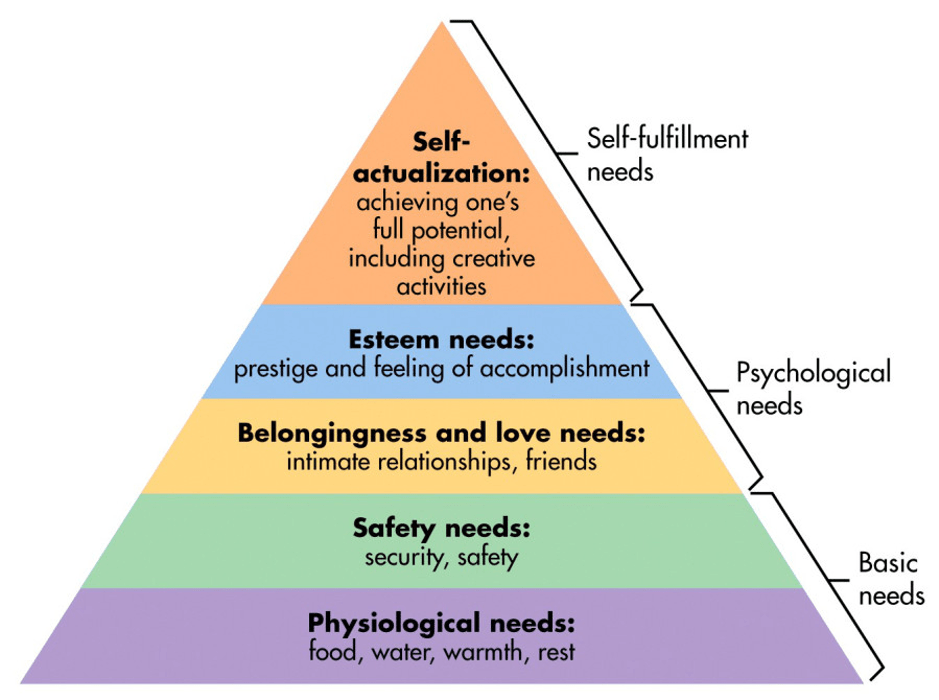
As we find ourselves in these unprecedented times with the Covid-19 pandemic, I can’t help but think about Maslow’s Hierarchy of Needs and the impact this is having on the psychological motivation of human beings across the world. In what feels like a blink of an eye, we have all shifted downwards to the lowest level of the hierarchy. Together (yet apart) we grapple to find some stability in social isolation and to try and satisfy our most basic physiological needs. Maslow’s theory, or five-stage model, talks a lot about an individual’s need for fulfilment within each tier, as a way of motivating us to move to the next level. So, if your basic needs are met, those required for human survival, such as shelter, food, drink and warmth then we move to the next level of safety needs. To feel safe and secure we need structure and order, normality and control of our lives. This extends way beyond how we feel in our individual minds, bodies and homes. To those social norms and the society that we have constructed together, such as schools, employment, social welfare and financial stability. Our socially constructed and shared reality has quite dramatically been fractured by an invisible virus, which makes me realise how fragile our human society really is. Nature truly has the power to breakdown all of our systems, to dispel the norms and reality we have social constructed together.

Maslow's Hierarchy of Needs
Maslow’s Hierarchy of Needs

So here we are together, but alone, in this new world. Asking ourselves these basic psychological questions: Do I feel safe and secure? Will my family be safe and survive Covid-19? Can I get access to food and drink? Will I have money to satisfy these basic needs? How long will I be isolated and alone?

Not least, get to grips with the fact that only weeks ago we may have been at the top of the hierarchy and achieved self-fulfilment. Perhaps in the form of a successful business, graduating from university or reaching an awesome milestone in a project. Whatever success might have looked like we are all now struggling to satisfy those basic needs. It really is a difficult time for us all. Some of us, of course, are more fortunate than others, some of us are less vulnerable. Indeed, some of us may even be able to fulfil those basic needs and find the motivation to move up the hierarchy. To discover new virtual ways of continuing to develop intimate relationships, to find a sense of belonging and love through the affordance of digital technology.

As human beings we have an innate ability to adapt, and although this will not happen without fear, anxiety and loss, it’s inevitable that we will collectively create new socially constructed norms. We can start this journey by being kind to ourselves, no personal pain is worth more than someone else’s. We should not feel guilty or compare our struggles. Be kind to each other and accept that we have all arrived at this basic psychological level together, but from different places. Let’s not judge each other’s pain or use social media shame. Let’s continue to look after the vulnerable and each other. Rather than individually moving up Maslow’s hierarchy of needs, let’s continue to do this collectively by creating more sociable virtual experiences, by staying connected and supportive. Most of all, by being kind and putting the safety of all of us first.

Stay Home, Save Lives and Create New Supportive Connections.

Investigating Technology Enhanced Learning: Reflections from the first workshop

Yay, the Investigating Technology Enhanced Learning module is my last taught module of the MEd Practitioner Enquiry Masters programme. This is the module I have been most excited about (although I have enjoyed all the other modules). I have worked at Newcastle University for almost two decades (yikes) but the MEd was my first opportunity to experience Newcastle from a student perspective. Through my work with Newcastle I have been fortunate to lead on many educational technology project (hence my excitement for this module). I have spent a few years leading on the coordination of 100% online programmes, and since March 2019 I have been leading on specific blended learning projects in my role as Learning Enhancement and Technology Projects Advisor (it’s a bit of a mouth full that one!).

Before the first workshop I had feelings of excitement and apprehension. Eager to enhance my theoretical knowledge of TEL and to be able to translate this into practice. Yet apprehensive for two reasons really, 1: the pressure I put on myself because of my experiences and the expectation from others because of that and 2: my demographics. Typically, the other modules I have studied have been with full-time students that have already formed their peer groups, and that may not have entered the world of work. Then here is me rocking up, the middle-aged, part-time student, full-time working Mum with limited hours to spare…😬 I was aware of course that I was perhaps at an advantage to others given my previous experience and I made a mental note to ensure I listened to what experiences my peers bring to the course (after all younger generations know a lot about technology) and to give them the opportunity to explore some the educational technologies that I may already have experience with.

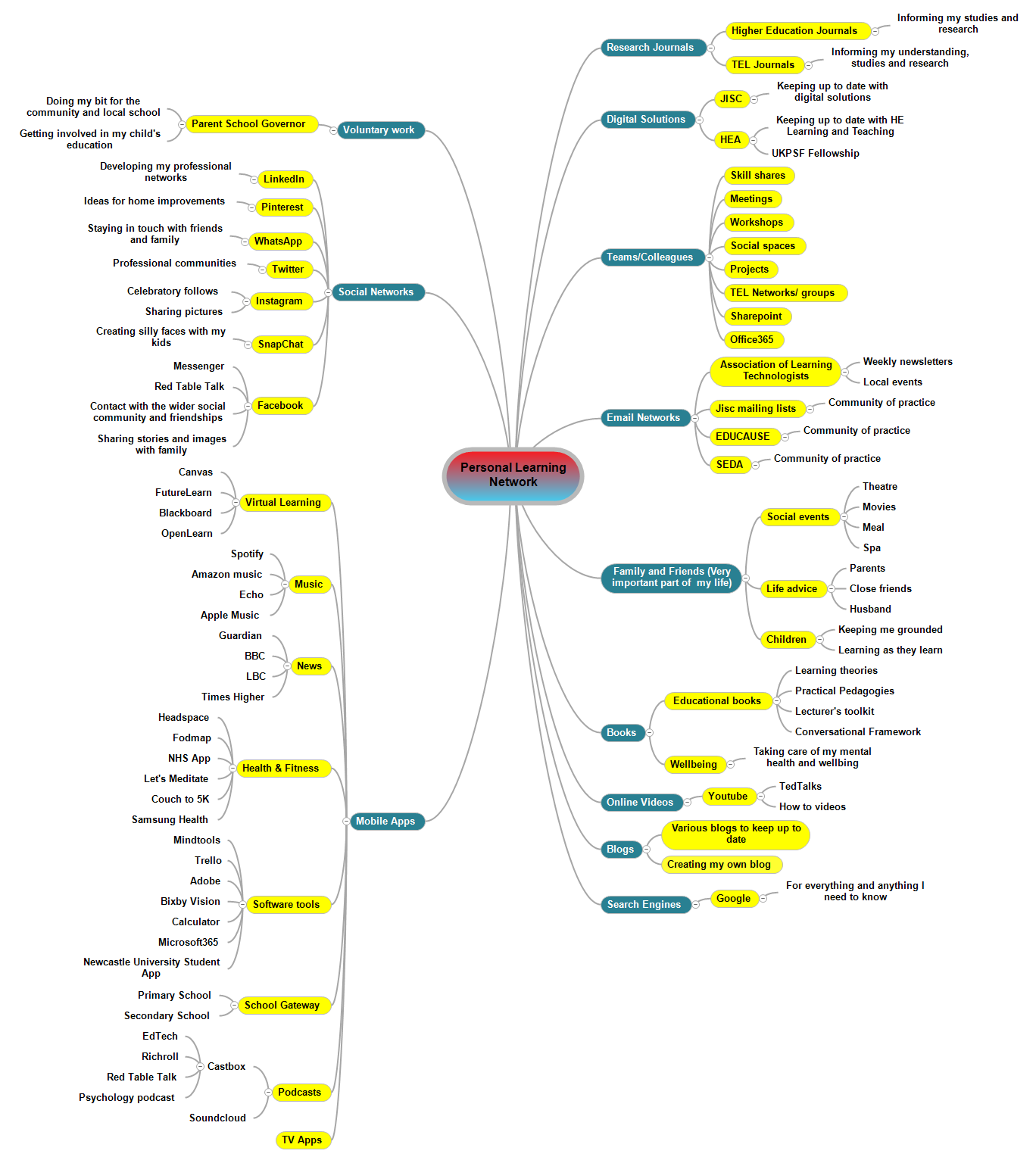
I was delighted when I got to the first workshop that it was a small student group, and a lovely student group. I of course was the only part-time mature student but that was OK because I was not the only ‘mature’ person in the room (sorry James 😊). Having a small student group, working together in a safe and inclusive environment really allows for critical reflection and social learning. Our first task was to create a personal learning network using paper and colour pens (yep…no matter how technology progresses there is still something tangible about flip charts and coloured pens). James asked us to map out our personal learning network so that we can identify our relationship with certain online technologies, and offline networks. I was really surprised at the many different sources of information and how I use these to expand my knowledge. The networks just kept expanding and it really hits home the impact of technology on all our lives. After the session I recreated my personal network using MindView, mind mapping software.

Personal Learning Network (Michelle Barr)

James also introduced us to blogging as a tool for refection (something I have not done before). I really felt the pressure in creating a blog that was publicly accessible with my views, especially as I work in the sector. This is perhaps why a faffed a lot creating my first blog page, style, image etc… and why my first blog, the home page setting the scene blog, had to make an academic splash, and didn’t really include what I really thought…

Design a site like this with WordPress.com
Get started